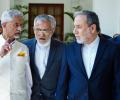
India has no intention to escalate tensions with Pakistan, but any military attacks on its soil will be met with a "very" firm response, External Affairs Minister S Jaishankar said on Thursday. Jaishankar made the remarks at a meeting with Iranian Foreign Minister Abbas Araghchi, emphasizing that the "barbaric" Pahalgam terror attack compelled India to carry out strikes on "cross-border" terror infrastructure on Wednesday. He reiterated that India's response was targeted and measured, but stressed that any further military attacks would be met with a firm response. The Iranian foreign minister, who landed in New Delhi amidst escalating tensions between India and Pakistan, called for de-escalation of the situation and stressed the need for regional cooperation to eradicate terrorism. The meeting also focused on boosting ties in areas of trade and investment, including the Chabahar port project.
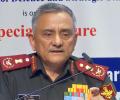
Pakistan's decision to talk to India on May 10 stemmed from realisation that it will suffer more if its operation continues, Gen Chauhan said.
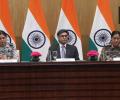
Colonel Sofiya Qureshi revealed that 300 to 400 drones were deployed across 36 locations, with several being shot down by Indian forces using both kinetic and non-kinetic methods.
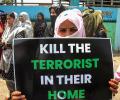
Amid rising tensions between India and Pakistan, the US has called on both countries "not to escalate" the conflict. Secretary of State Marco Rubio is expected to speak with the foreign ministers of Pakistan and India as early as today or tomorrow. The US State Department said Washington is reaching out to both India and Pakistan "regarding the Kashmir situation" and telling them "not to escalate the situation."

Rejecting the criticism of the CAA, Jaishankar said, "There are people who publicly said on record that because of CAA, a million Muslims will lose their citizenship in this country."

"China is an absolutely impossible factor to ignore in what has been our confrontation with Pakistan," Tharoor said.

Chief of Defence Staff General Anil Chauhan on Saturday acknowledged losses of aircraft in India's recent military hostilities with Pakistan but dismissed as 'absolutely incorrect' Islamabad's claim of downing six Indian fighter jets.

Prime Minister Narendra Modi on Friday said the world has seen the power of India's indigenous weapons during Operation Sindoor, which is 'not over yet'.

Congress leader Rahul Gandhi visited Poonch in Jammu and Kashmir, offering condolences to families affected by cross-border shelling and encouraging students who lost two classmates to the violence. During an hour-long visit, Gandhi met with students at the convent school that lost the twins, and visited families whose homes were damaged in the shelling.

Pakistan's Ambassador to the US, Rizwan Saeed Sheikh, has urged President Donald Trump to help ease tensions with India, highlighting the Kashmir issue as a "flash point" in nuclear terms. He believes that the US should take a more comprehensive and sustained approach to address the situation rather than just immediate de-escalatory measures.
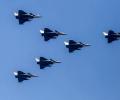
The Congress' Uttar Pradesh chief Ajay Rai's symbolic gesture of hanging 'nimbu-mirchi' (lemon-chillies) on a toy jet, mocking the Centre's alleged inaction in the wake of the Pahalgam attack, has triggered a political storm. The BJP has condemned the act, calling it an insult to the armed forces. Rai, however, maintained that he was merely highlighting the government's delay in utilizing the Rafale jets. The controversy comes amidst a heated debate over the government's response to the recent terror attack.

The political and ideological differences between the Congress and Shashi Tharoor is no longer a matter of whispers.

India has strongly condemned Pakistan's recent drone attacks on Indian cities and civilian infrastructure, calling it a "deranged fantasy" and a desperate attempt to deceive the world. Foreign Secretary Vikram Misri also accused Pakistan of attacking religious sites, including a gurdwara in Amritsar, in an attempt to give a communal color to the situation. Misri criticized Pakistan's "blatantly farcical denial" of the attacks and said the country is resorting to disinformation tactics.

The Russian Federal Security Service (FSB) on Monday said that its officers had detained a suicide bomber, a member of the Islamic State terrorist group, who was plotting a terrorist attack against one of India's leadership elite, Russia news agency Sputnik reported.
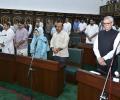
The Jammu and Kashmir assembly unanimously passed a resolution on Monday expressing shock and anguish over the terrorist attack in Pahalgam and resolved to fight resolutely to defeat the nefarious designs to disturb communal harmony and hinder progress.

Assam Chief Minister Himanta Biswa Sarma on Sunday alleged that Congress MP Gaurav Gogoi visited Pakistan on an invitation from its spy agency Inter-Services Intelligence, and that he worked closely with the establishment of the neighbouring nation.
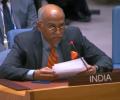
India's Permanent Representative to the UN, Ambassador Parvathaneni Harish, has sharply criticized Pakistan, calling it the "global epicenter of terrorism" and accusing it of providing state support to cross-border terrorism. Harish's remarks came in response to Pakistan's Deputy Prime Minister and Minister of Foreign Affairs Mohammed Ishaq Dar's comments on Jammu and Kashmir during a UN Security Council meeting. India highlighted that Pakistan harbors over 20 UN-listed terrorist entities and has a history of supporting groups like Jaish-e-Mohammed and Harkat Ul Mujahidin. India also emphasized that Jammu and Kashmir is an integral part of India and that Pakistan's misinformation campaign does not change the reality on the ground.

In a remarkable display of resilience and commitment to democracy, the residents of villages that had long been deprived of polling due to terrorist threats and separatist-sponsored boycott calls turned out in large numbers to cast ballots in the sixth phase of Lok Sabha polls on Saturday.

Chief of Air Staff Air Chief Marshal A P Singh on Thursday flagged serious concerns over inordinate delays in various defence acquisition projects and failure to stick to delivery schedules for supply of key platforms even as he hailed Operation Sindoor as a 'national victory'.
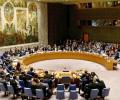
The United Nations Security Council held closed-door consultations on rising tensions between India and Pakistan, with envoys calling for restraint and dialogue. The consultations, requested by Pakistan, lasted for about an hour and a half. UN Secretary-General Antonio Guterres expressed concern over the tensions, urging both countries to avoid a military confrontation. India's former Permanent Representative to the UN, Syed Akbaruddin, said that no consequential outcome could be expected from the discussion.

UN Secretary-General Antnio Guterres expressed concern over the heightened tensions between India and Pakistan, calling for maximum restraint and urging both countries to step back from the brink. Guterres offered his "good offices" to both governments in the service of peace and condemned the recent terror attack in Pahalgam, emphasizing the need to bring those responsible to justice. He also stressed that a military confrontation would be detrimental and could easily spin out of control. His remarks came hours before a closed consultation of the UN Security Council on the matter, requested by Pakistan. The UN Secretary-General highlighted the need for de-escalation, diplomacy, and a renewed commitment to peace.
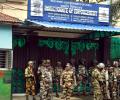
The Supreme Court of India has repeatedly criticized the Enforcement Directorate (ED) for exceeding its authority and misusing its powers. The latest rebuke came on Thursday, when the court accused the agency of 'crossing all limits' in a money laundering probe against a Tamil Nadu state-run liquor retailer. This follows a string of similar observations by the Supreme Court and high courts across India, raising concerns about the ED's investigative practices and the potential for misuse of its powers.
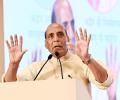
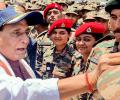
Defence Minister Rajnath Singh on Sunday said it is his responsibility to work with the armed forces and give a "befitting reply" to those who cast an evil eye on India, his remarks coming in the backdrop of the recent Pahalgam terror attack. Singh's assertion came as India is mulling retaliatory measures against Pakistan in view of the cross-border linkages to the April 22 Pahalgam terror attack that has killed 26 people, mostly tourists. He said, "As the defence minister, it is my responsibility to work with my soldiers and ensure the protection of the country's borders. And it is my responsibility to give a befitting reply, by working with the armed forces, to those who cast an evil eye on our country."

"What we have heard today only confirms what we have been saying consistently all along -- Canada has presented us no evidence whatsoever in support of the serious allegations that it has chosen to level against India and Indian diplomats," the MEA spokesperson said in the statement.
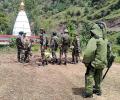
'Unfortunately, India and Pakistan could learn a 'lesson' from this conflict that will make them more likely to use these weapons against each other in the future.' 'Rounds of missile and drone attacks could be more routine features of their hostility, just like artillery fire has become a familiar fact of life along the Line of Control.'
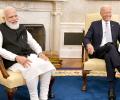
When asked if Modi and Singh's comments can be seen as "confessions" on the alleged "assassination of (Khalistani separatist Hardeep Singh) Nijjar in Canada, (designated terrorist Gurpatwant Singh) Pannu's murder-for-hire plot in New York, and killings in Pakistan", Miller said the US will not get involved in the matter.

Congress spokesperson Atul Londhe Patil lashed out at Prime Minister Narendra Modi and Maharashtra Chief Minister Devendra Fadnavis and questioned the need for Rane to remain part of the cabinet.
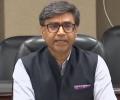
India has accused Pakistan of breaching an understanding reached earlier on Saturday to stop military actions. Foreign Secretary Vikram Misri said there have been repeated violations of the understanding since the evening, and that the Indian armed forces are giving an appropriate response.

'We've moved from thousands killed yearly in Jammu and Kashmir to 127 last year.' 'Cross-border terrorism in Kashmir is being solved. We are winning it.'
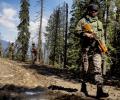
Pakistan has warned the international community that any military moves by India shall be 'responded to assuredly and decisively... onus of any escalatory spiral and its consequences shall squarely lie with India.' Implicit in the statement is a veiled threat that even a nuclear threshold may be reached if push comes to shove, warns Ambassador M K Bhadrakumar.
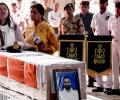
'If Pakistan's army wants to escalate violence in Kashmir, they have an unlimited supply of jihadis they can train and send. That's not an issue for them.'

Ranjani Srinivasan, an Indian student at Columbia University, has left the United States after her student visa was revoked over allegations of supporting Hamas. Srinivasan, a PhD student in Urban Planning, claims her visa was revoked for engaging in protected political speech. The Trump administration has been accused of targeting pro-Palestinian demonstrators through the use of federal immigration powers, and this case has drawn attention to the potential for free speech suppression in the United States.

Union Home Minister Amit Shah has stated that Naxalism, currently confined to just four districts in India, will be completely eradicated by March 31, 2026. He emphasized the crucial role of the Central Reserve Police Force (CRPF), particularly its CoBRA battalion, in achieving this goal. Shah lauded the CRPF's contributions to national security, highlighting their efforts in combating terrorism in Kashmir, maintaining peace in the Northeast, and significantly reducing Naxal violence. He also paid tribute to the CRPF's sacrifices, acknowledging the loss of 2,264 personnel in the line of duty.

The reality is that far from being friendless, India is better positioned in the world than at any point post-Cold War, asserts Shekhar Gupta.
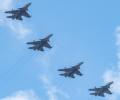
Pakistani military targets at Rafiqui, Murid, Chaklala, Rahim Yar Khan, Sukkur and Chunian were engaged using air-launched precision weapons from Indian fighter jets and the retaliation largely focused on command and control centres, radar sites and weapon storage areas, Qureshi said.

Swati Maliwal alleged that Atishi's family fought for terrorist Afzal Guru in order to save him from capital punishment.
'You can be sure that the Pakistanis knew when the Indian Air Force aircraft took off, which type these were, and what their likely targets were.' 'The question was: How would they determine that the IAF wanted to fire, and when to bounce them?', notes Shekhar Gupta.

Trump bought the car in a show of support for Musk's electric vehicle company, which is facing a major backlash because of the Tesla CEO's work to advance the President's political agenda.

Meanwhile, a precautionary blackout has been enforfced in the multiple areas amid the esclating tensions between India and Pakistan.
'One good outcome of Operation Sindoor -- perhaps, its best outcome -- could be that India has resumed meaningful contact directly with Pakistan at the military-to-military level,' observes Ambassador M K Bhadrakumar.
